
Tutorial 6: Getting started with Referencing
In this Tutorial you will consider:
- What referencing is and why it is important
- The difference between quotations, paraphrases and summaries
- An introduction to different referencing systems used at Morling
More about Quotations
More about Quotations
What is a quotation?
A quotation is an exact reproduction of spoken or written words. Direct quotes can provide strong evidence, act as an authoritative voice, or support a writer's statements. For example:
Critical debates about the value of popular culture often raise the spectres of Americanisation and cultural imperialism, particular issues for a 'provincial' culture. However, as Bell and Bell point out in their study of Australian-American cultural relations: "culture is never simply imposed 'from above' but is negotiated through existing patterns and traditions" (citation here as in-text or footnote).
How to quote
Make sure that you have a good reason to use a direct quotation. Quoting should be done sparingly and should support your own work, not replace it. For example, make a point in your own words, then support it with an authoritative quote.
- Every direct quotation should appear between quotation marks (" ") and exactly reproduce text, including punctuation and capital letters.
- A short quotation often works well integrated into a sentence.
- Longer quotations (more than 3 lines of text) should start on a new line, be indented. It should also be single spaced. This is called a Block Quote.
When to quote
- When the author's words convey a powerful meaning.
- When you want to use the author as an authoritative voice in your own writing.
- To introduce an author's position you may wish to discuss.
- To support claims in, or provide evidence for, your writing.
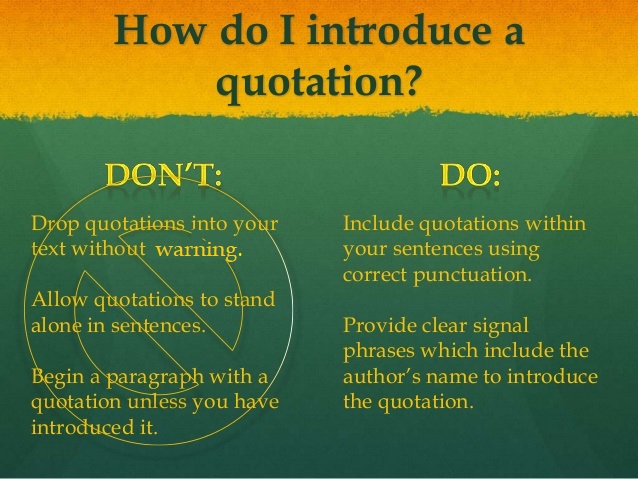
Useful verbs and phrases for introducing direct quotes
- As X states/ believes/ suggests /indicates/ points out / observes/ explains/ argues/ outlines/ contradicts / proposes, “…….”.
- For example, X has argued that “……”.
- According to X, “…….”.
X suggests/ believes/ observes that “…..”.
More information
Quoting authors from UNE (note this uses APA referencing)
Activity: Practice Quoting
Use the following passage from page 24 of
Strauss, Mark L. Four Portraits, One Jesus : An Introduction to Jesus and the Gospels. Grand Rapids, Mich.: Zondervan, 2007.
Write two sentences, one of which contains an exact quotation from this text.
Each of the four Gospels-Matthew, Mark, Luke, and John-paints a unique portrait of Jesus Christ. Each provides special insight into who he is and what he accomplished. The Gospels exhibit both unity and diversity, bearing witness to the same Jesus (unity) but viewing him from unique perspectives (diversity). What are these four unique portraits? At the risk of oversimplifying, we may say that Matthew presents Jesus as the Jewish Messiah, the fulfillment of Old Testament hopes; Mark portrays him as the suffering Son of God, who offers himself as a sacrifice for sins; Luke's Jesus is the Savior for all people, who brings salvation to all nations and people groups; and in John, Jesus is the eternal Son of God, the self-revelation of God the Father. These are not contradictory portraits but complementary ones. Having four Gospels gives us a deeper, more profound understanding of Christology -the nature of Jesus' person and work.