
Tutorial 6: Getting started with Referencing
In this Tutorial you will consider:
- What referencing is and why it is important
- The difference between quotations, paraphrases and summaries
- An introduction to different referencing systems used at Morling
More about paraphrasing
More about paraphrasing
What is paraphrasing?
Paraphrasing is a way of presenting a text, keeping the same meaning, but using different words and phrasing. Paraphrasing is used with short sections of text, such as phrases and sentences.
A paraphrase may result in a longer, rather than shorter, version of the original text. It offers an alternative to using direct quotations and helps students to integrate evidence/ source material into assignments. Paraphrasing is also a useful skill for making notes from readings, note-taking in lectures, and explaining information in tables, charts and diagrams. 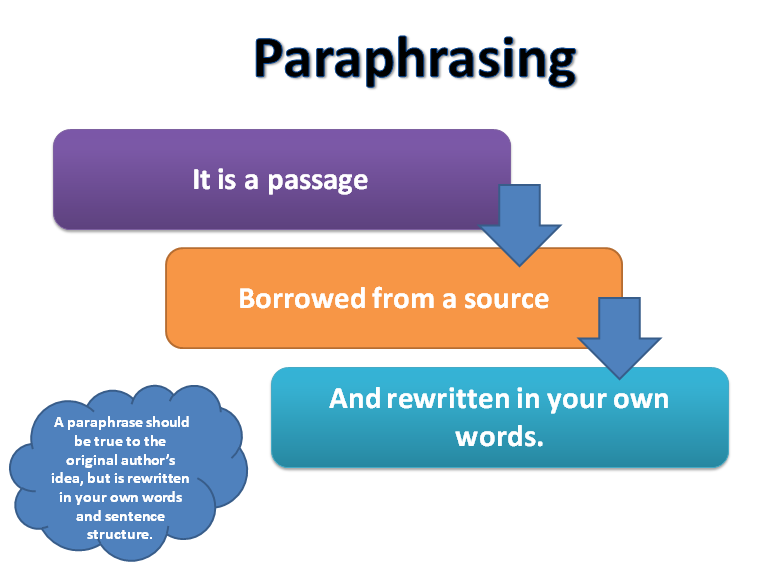
How to paraphrase
- Read the source carefully. It is essential that you understand it fully.
- Identify the main point(s) and key words.
- Cover the original text and rewrite it in your own words. Check that you have included the main points and essential information.
- Write the paraphrase in your own style. Consider each point; how could you rephrase it?
- Meaning: ensure that you keep the original meaning and maintain the same relationship between main ideas and supporting points.
- Words: Use synonyms (words or expression which have a similar meaning) where appropriate. Key words that are specialised subject vocabulary do not need to be changed.
- If you want to retain unique or specialist phrases, use quotation marks (““).
- Change the grammar and sentence structure. Break up a long sentence into two shorter ones or combine two short sentences into one. Change the voice (active/passive) or change word forms (e.g. nouns, adjectives).
- Change the order in which information/ ideas are presented (as long as they still make sense in a different order).
- Identify the attitude of the authors to their subject (i.e. certain, uncertain, critical etc.) and make sure your paraphrase reflects this.
- Review your paraphrase checking that it accurately reflects the original text but is in your words and style.
- Record the original source (including the page number) so that you can provide a reference.
When to paraphrase
- Paraphrase short sections of work only; a sentence or two or a short paragraph.
- As an alternative to a direct quotation.
- To rewrite someone else's ideas without changing the meaning.
- To express someone else's ideas in your own words.
- To support claims in, or provide evidence for, your writing.
More information
Pharaphrasing authors from UNE (note this uses APA referencing)
(image from http://1.bp.blogspot.com/-Rp1xL8ptPTE/UVF3dILcwfI/AAAAAAAAAF0/ajdgJSoMvIQ/s1600/paraphrase.png)
Activity: Practice Paraphrasing
Use the following passage from page 24 of
Strauss, Mark L. Four Portraits, One Jesus : An Introduction to Jesus and the Gospels. Grand Rapids, Mich.: Zondervan, 2007.
Write three sentences to paraphrase this paragraph.
This little story is a good analogy for the New Testament Gospels. Each of the four Gospels-Matthew, Mark, Luke, and John-paints a unique portrait of Jesus Christ. Each provides special insight into who he is and what he accomplished. The Gospels exhibit both unity and diversity, bearing witness to the same Jesus (unity) but viewing him from unique perspectives (diversity). What are these four unique portraits? At the risk of oversimplifying, we may say that Matthew presents Jesus as the Jewish Messiah, the fulfillment of Old Testament hopes; Mark portrays him as the suffering Son of God, who offers himself as a sacrifice for sins; Luke's Jesus is the Savior for all people, who brings salvation to all nations and people groups; and in John, Jesus is the eternal Son of God, the self-revelation of God the Father. These are not contradictory portraits but complementary ones. Having four Gospels gives us a deeper, more profound understanding of Christology -the nature of Jesus' person and work.